
Why Digital Health Matters in Africa - and Why It Cannot Wait
A 10-minute read for anyone who cares about the future of healthcare in Africa - from patients to policymakers, investors to innovators. The case for and against investing in digital health on the continent – and what doing it properly looks like.
The crisis behind the opportunity
Let us start with a number that should stop you in your tracks: 1.55.
That is the number of doctors, nurses, and midwives available for every 1,000 people across the African region - less than one-third of the 4.45 per 1,000 that the World Health Organization (WHO) says is the minimum needed to deliver essential health services.1 Only four countries on the entire continent - Mauritius, Namibia, Seychelles, and South Africa - have crossed that threshold.1
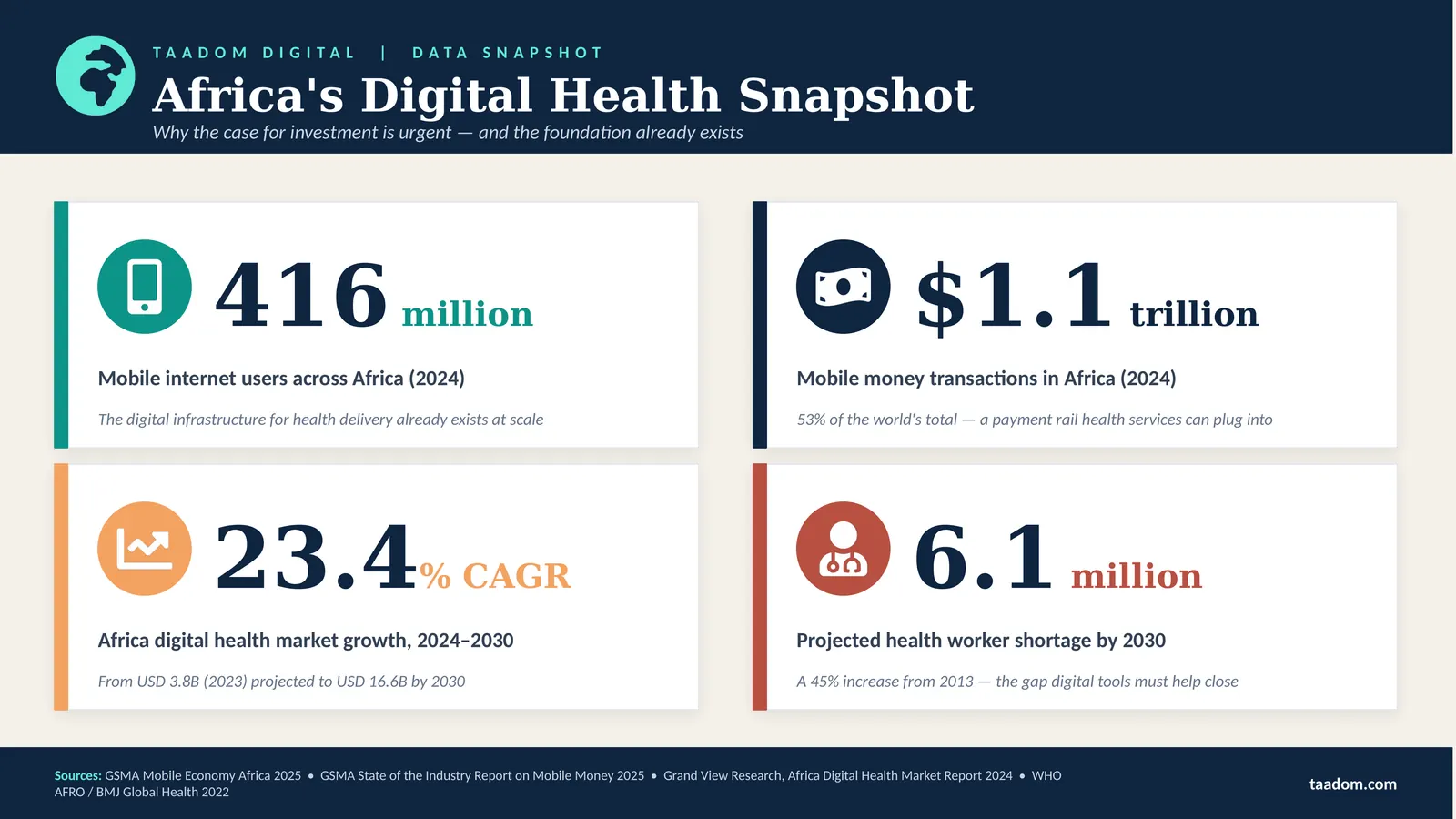
Put another way: sub-Saharan Africa carries roughly 25% of the world’s disease burden but is served by barely 1.3% of the global healthcare workforce.2 Malaria kills an estimated 600,000 people each year.3 Families in many countries spend 25 to 40% of their income out of pocket on healthcare - catastrophic expenditure that pushes millions below the poverty line every year.4 And by 2030, projections suggest the health workforce shortage on the continent will reach 6.1 million.1
These are not abstract statistics. They are mothers who cannot access a skilled birth attendant. They are children with preventable infections that escalate because a diagnosis came too late or not at all. They are rural communities where the nearest clinic is hours away and the doctor, if there is one, is already managing 50 patients before noon.
But here is what makes this story different from every other grim headline about African health: there is a credible, evidence-backed, and already-emerging pathway out of this crisis. It runs through your phone.
What is digital health, and why does it matter here?
Digital health is the use of technology - mobile phones, the internet, artificial intelligence (AI), electronic health records, wearable devices, and data systems - to improve how health services are delivered, managed, and experienced.5 In high-income countries, it is largely a matter of convenience - digital tools supplement systems that already work. In Africa, it is a matter of survival.
The continent is not starting from zero. As of 2024, Africa had 416 million mobile internet users, and the continent is projected to add over 100 million new mobile subscribers by the end of 2025.6 Mobile money - the infrastructure that underpins mobile health payments - processed USD 1.1 trillion in transactions in 2024, representing 53% of the world’s total mobile money volume.6 More than 40 countries on the continent have deployed DHIS2, a digital platform for national health data management, replacing entirely manual, paper-based systems.5
This infrastructure is not just impressive. It is the foundation upon which a digital health revolution is already being built - imperfectly, unevenly, but unmistakably.
The case for: why digital health can change everything
1. Reaching the unreachable
The most immediate power of digital health is geographic. When the nearest hospital is a four-hour walk and the nearest specialist does not exist in your district, a phone consultation is not a luxury - it is the only consultation you will ever get.
Telemedicine platforms are already demonstrating this. Babyl Rwanda operates using USSD technology - the same simple text menus used by feature phones - meaning it reaches communities where smartphones are still rare.7 The platform works directly within Rwanda’s national healthcare infrastructure, extending access to populations who would otherwise go without. In Ethiopia, telemedicine pilots have slashed the need for patients to travel long distances to urban hospitals for specialist consultations.8 In Kenya and Uganda, mobile-based maternal health interventions - appointment reminders, dietary guidance, and safe delivery information delivered via SMS - have contributed to reductions in maternal and neonatal mortality.8
In Cameroon, the TELEMED-CAM study specifically assessed the role of telemedicine in controlling hypertension in rural villages, connecting patients to care that would otherwise have been inaccessible.9
These are not pilot projects. They are proof of concept at scale.
2. Multiplying a scarce workforce
When you cannot train enough doctors fast enough to keep up with population growth - and Africa’s population is outpacing its health workforce development10 - the logical response is to make every health worker more powerful. Digital tools do precisely that.
Kenya’s Community Health Strategy has equipped over 60,000 community health volunteers with digital tools for patient tracking and data collection, extending the reach of the formal health system deep into communities that clinics cannot serve.11 AI-powered diagnostic support tools - which can flag abnormal results, suggest differential diagnoses, and flag drug interactions - allow a nurse or community health worker to make better decisions even without a physician in the building.
AI is estimated to lead to 5–10% cost savings in the health sector, and globally, AI implementations in healthcare are projected to contribute substantially to economic value by 2030.12 In the African context, where every dollar spent on healthcare must do the work of three, that efficiency gain is not incremental - it is transformative.
3. Making diseases visible
You cannot manage what you cannot measure. One of the most crippling weaknesses of African health systems has been the near-total invisibility of disease burden at the subnational level - not because the diseases were not there, but because the data systems to capture them were not.
Digital health changes this. DHIS2 now powers national health information systems in over 40 African countries, generating real-time data on disease outbreaks, vaccination coverage, commodity stock-outs, and patient flows.5 This data does not just describe the problem after the fact - it enables prediction, prevention, and rapid response. During COVID-19, digital tools for contact tracing, case management, and vaccination certification were deployed across the continent at speed, demonstrating that the infrastructure for a coordinated digital response exists and can be activated when the political will is present.5
4. The market is already moving
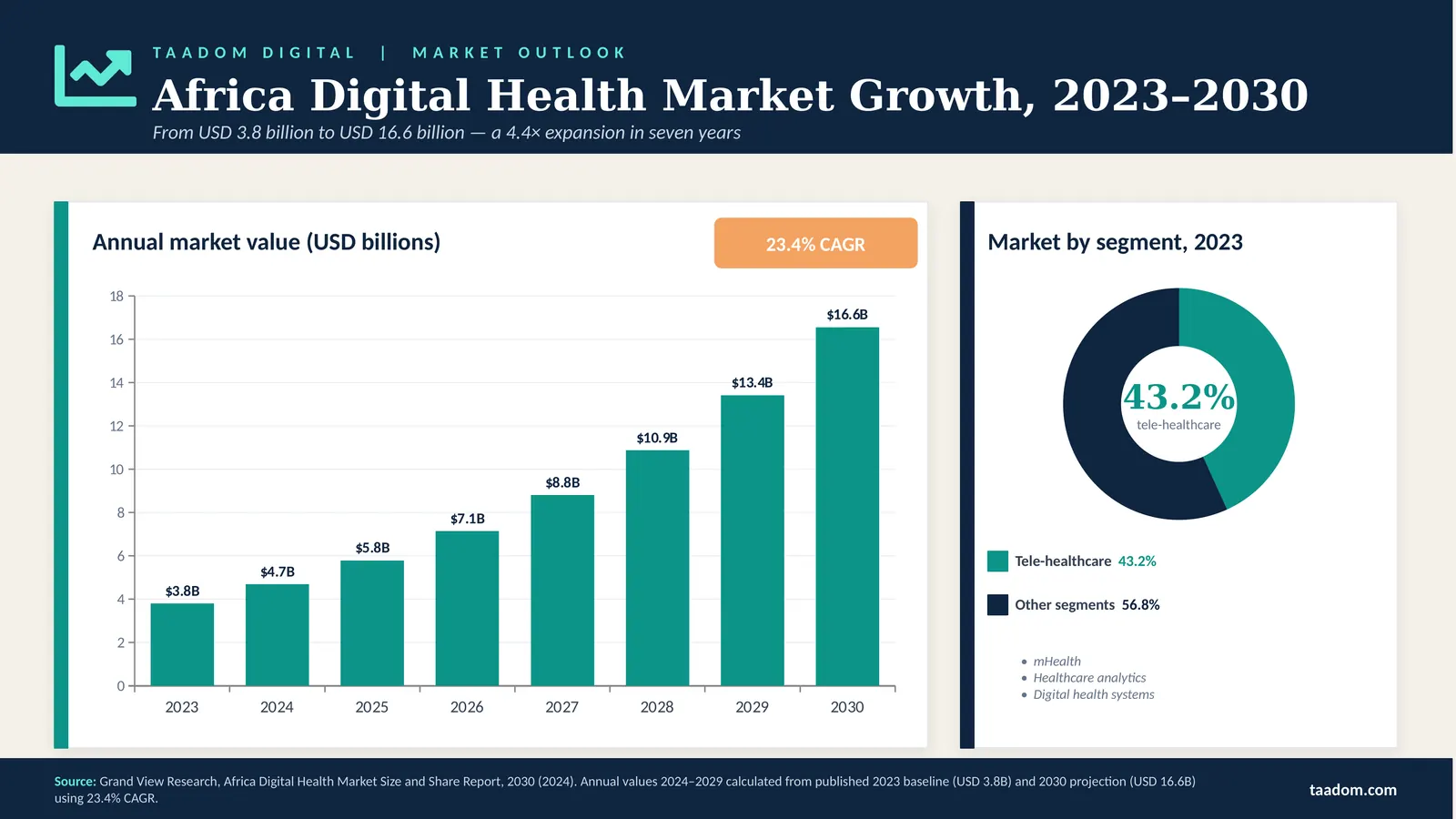
Investors are paying attention. The Africa digital health market was valued at USD 3.8 billion in 2023 and is projected to grow at a CAGR of 23.4% from 2024 to 2030, reaching USD 16.6 billion.13 The telehealth segment alone accounted for 43.2% of that market in 2023.13 In early 2025, the Gates Foundation committed USD 5 million to healthtech initiatives specifically addressing resource gaps across the continent, while NEPAD’s agency provided USD 12 million in catalytic grants to over 250 young innovators developing telemedicine platforms and AI-powered diagnostics.14
In October 2025, the WHO and the European Union announced an EUR 8 million joint initiative to strengthen digital health system transformation across sub-Saharan Africa.6 These are not charity gifts. They are strategic investments in a sector that is demonstrating measurable returns.
The case against: Why Sceptics Have a Point
It would be dishonest - and frankly irresponsible - to write a cheerleading article without addressing the legitimate criticisms. They deserve serious engagement.
1. The digital divide is real and dangerous
Internet penetration in rural sub-Saharan Africa stands at just 23%, compared to 57% in urban areas, according to ITU 2024 data.11 This is not a minor gap. It means that the communities who most need better healthcare - poor, rural, remote - are the same communities least likely to benefit from digital health solutions designed without them in mind.
If digital health investment flows primarily to urban centres, private clinics, and tech-savvy populations, it risks deepening the very inequities it claims to address. A telemedicine app that requires a smartphone, a stable internet connection, and a credit card for payment is, by definition, not a tool for the most vulnerable. In 2025, 43 out of 54 African countries still lacked full digital health plans.3 Without deliberate, equity-centred design, digital health can become a luxury.
2. The sustainability problem
Many of the digital health programmes that have demonstrated impact in Africa were launched with donor funding - from USAID, the Bill & Melinda Gates Foundation, or UN agencies. What happens when the grant ends? Many digital health initiatives struggle when transitional funding runs out, leaving behind either abandoned platforms or systems that governments cannot afford to maintain.11 The graveyard of well-intentioned health technology projects in Africa is real and well-documented.
Sustainability demands that digital health tools be embedded in national health strategies, budgeted for in government plans, and designed from the start with a path to domestic financing. Too often, this discipline is absent.
3. Data privacy and the risk of surveillance capitalism
This is perhaps the most philosophically unsettling concern. As health data becomes more digital, it also becomes more valuable - and more vulnerable. The rapid growth of digital health technologies has outpaced regulatory oversight in many countries, exposing users to risks related to data privacy, security, and ethical concerns.15
In South Africa, a data breach at the National Health Laboratory Service exposed the sensitive health records of thousands of patients due to insufficient cybersecurity measures and unauthorised third-party access.15 Critics have pointed to a broader dynamic: the digitisation of health in sub-Saharan Africa has led to increased commercialisation of healthcare, with private actors gaining increasing control over health data and government systems.16 One scholar has described the logic of data-driven digital economies as “surveillance capitalism” - a framework in which user data becomes the raw material for commercial value extraction.16
These concerns are not hypothetical. They are grounded in documented cases and require robust regulatory responses.
4. Interoperability and fragmentation
One of the most practical problems in African digital health is that systems do not talk to each other. A patient moves from one clinic to another, and their records do not follow. Three clinics near each other may use different apps; the patient moves, records vanish, and treatment starts over - wasted drugs, lost trust.3 A 2025 analysis of 11 African national digital health plans found that most lacked detail on interoperability, workforce development, legal frameworks, and financing.6 DHIS2 works well as a surveillance and reporting tool, but interoperability with electronic laboratory information systems, pharmacy systems, and clinical records remains incomplete across most of the continent.5
So should we invest? The verdict
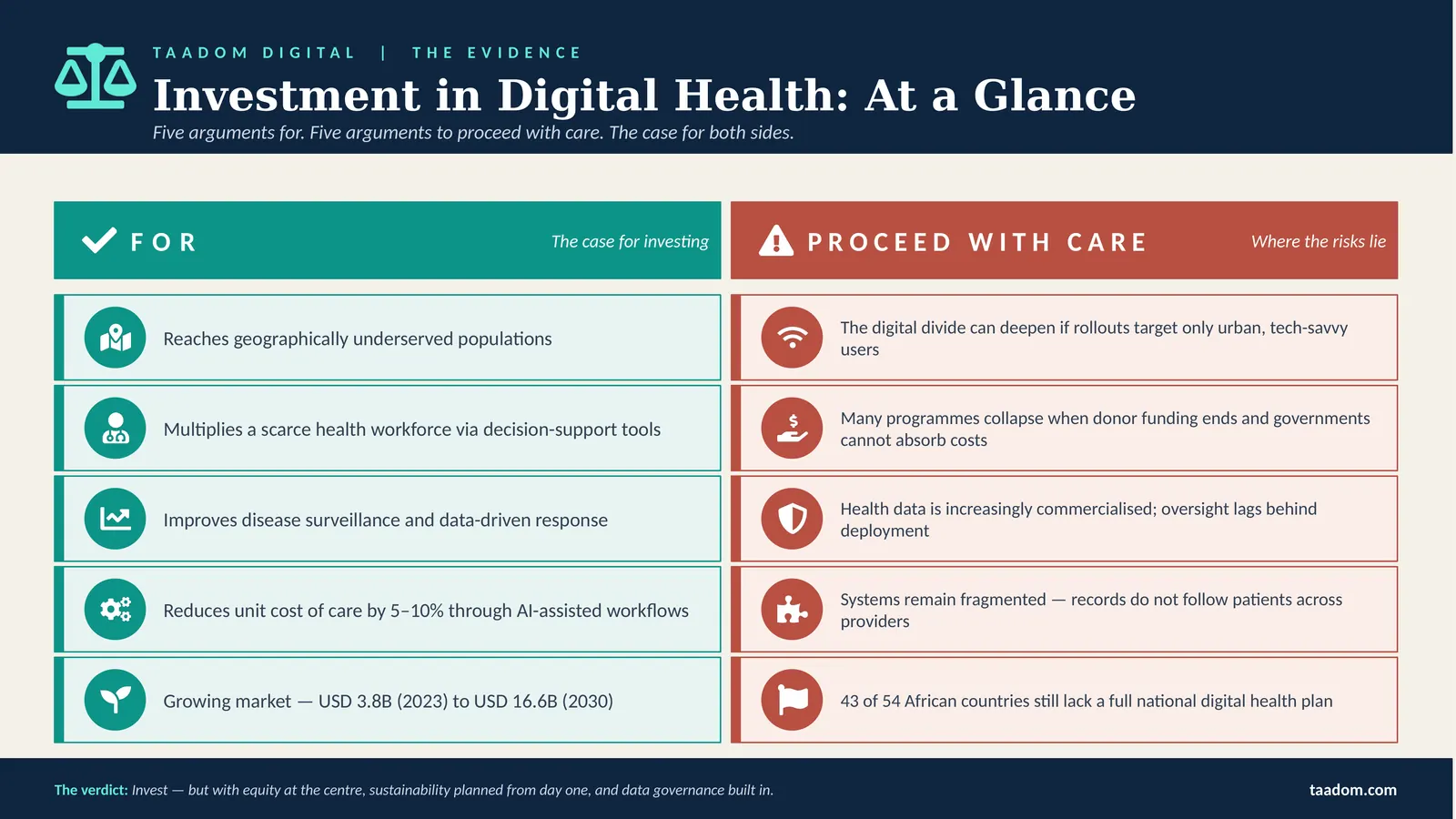
Yes. But with eyes open, and on specific conditions.
The case against digital health is really a case for doing it properly. None of the sceptical arguments - the digital divide, sustainability, data privacy, fragmentation - is an argument against digital health in principle. They are arguments against digital health done carelessly, without equity at the centre, without regulatory frameworks in place, and without genuine co-design with the communities being served.
The alternative - doing nothing, waiting for health system conditions to improve before deploying digital tools - is not a neutral option. It is a choice to let preventable deaths continue at scale, in a context where the technological capacity to reduce them demonstrably exists.
Consider the asymmetry: the Africa digital health market is expected to grow from USD 3.8 billion to USD 16.6 billion by 2030.13 That growth will happen with or without African-led, African-designed, equity-centred solutions. The question is not whether digital health will transform African healthcare - it already is. The question is whether that transformation will be shaped by and for Africans, or whether it will be imported wholesale from contexts that bear no resemblance to the realities of rural Cameroon, northern Nigeria, or eastern DRC.
That is precisely the gap that organisations and ventures like Taadom Digital exist to close.
What good digital health in Africa looks like
The evidence from successful implementations converges on a set of clear design principles.
Work with what people already have. Babyl’s use of USSD rather than smartphone apps is not a workaround - it is a design choice that prioritises access over elegance.7 Offline-capable apps that sync when connectivity is available, solar-powered devices for facilities with unreliable electricity, and SMS-based health information all meet people where they are rather than where we wish they were.
Build on community health workers. Community health workers (CHWs) are already the primary interface between formal health systems and underserved communities across Africa. Digital tools that augment and support CHWs - rather than replacing the human relationship with a screen - are consistently the most effective and most trusted. Kenya’s model of equipping CHWs with digital patient tracking tools has demonstrated this at scale.11
Design for interoperability from day one. The African Union’s Health Information Exchange Guidelines now mandate HL7/FHIR standards for cross-border data sharing.6 Any new digital health system that is not built to these standards is building a future data silo. The cost of retrofitting interoperability later is always higher than designing for it upfront.
Invest in data governance, not just data collection. Kenya’s Digital Health Act 2023 - despite an initial court suspension due to concerns about community consultation - represents the most detailed legislative instrument on digital health data governance on the continent.16 Every country deploying digital health tools needs a comparable framework: one that protects patient privacy, establishes who owns health data, and creates accountability mechanisms for both public and private actors.
Pursue local innovation, not just technology transfer. The quality of African digital health entrepreneurship has improved substantially. Unlike earlier ventures led primarily by technologists with limited health experience, the current generation of founders combines clinical training with technical expertise and deep local market knowledge.11 This matters because solutions designed by Africans, for African contexts, are structurally more likely to survive the withdrawal of external funding than those designed elsewhere and adapted.
Three models that work today
- Babyl Rwanda – USSD-based telemedicine integrated into the national health system, reaching feature-phone users.7
- Kenya’s CHW digital platform – over 60,000 community health volunteers using digital tools for patient tracking and data collection.11
- DHIS2 across 40+ African countries – national health data management replacing paper-based reporting and enabling rapid outbreak response.5
What happens if we get this right
Imagine a community health worker in a rural village in the Centre region of Cameroon, equipped with a smartphone loaded with an offline-capable diagnostic support app. She collects vital signs with a low-cost connected device, photographs a suspected lesion, and receives an AI-assisted differential diagnosis within seconds - not because a doctor is physically present, but because the intelligence of a trained clinician has been encoded into a tool she can carry in her pocket. The patient’s record is automatically logged to the national health information system. If the result is flagged as high priority, an alert reaches the nearest district hospital before the patient has even left the CHW’s door.
This is not science fiction. Every component of this scenario exists today, somewhere in Africa, in some form. The challenge is not invention - it is integration, sustainability, and equity of access.
If done right, digital health in Africa does not just make existing health systems marginally more efficient. It fundamentally restructures who gets care, when they get it, and how much it costs. It converts the continent’s extraordinary mobile infrastructure from a platform for commerce into a platform for survival. And it positions Africa not as a recipient of global health technology, but as a generator of innovations that the rest of the world will eventually learn from.
The clock is running
Africa’s health crisis is urgent. The digital tools to address it are available. The infrastructure to deploy them is growing. The evidence base for what works and what does not is accumulating.
What remains scarce is the disciplined, equity-centred, locally-rooted investment required to turn scattered pilots into sustainable national systems. Every year of delay is not a neutral pause - it is a year of preventable deaths, preventable impoverishment, and preventable suffering.
At Taadom Digital, we believe the future of healthcare in Africa will be digital. We also believe it must be African - designed with communities, governed by principles of equity and data sovereignty, and built to last beyond the first grant cycle.
The question is not whether to invest in digital health in Africa. The question is whether we will do it with the seriousness this moment demands.
The future of healthcare in Africa will be digital. The question is whether it will be African.
References
Footnotes
-
World Health Organization Regional Office for Africa. Chronic staff shortfalls stifle Africa’s health systems: WHO study. WHO AFRO; 2022. https://www.afro.who.int/news/chronic-staff-shortfalls-stifle-africas-health-systems-who-study ↩ ↩2 ↩3
-
Dussault G, Franceschini MC. Shortage of healthcare workers in developing countries – Africa. Ethn Health. 2006. https://pubmed.ncbi.nlm.nih.gov/19484878/ ↩
-
MOHAC Africa. Technology in African healthcare: 2026 digital health innovations. 2026. https://mohacafrica.org/technology-in-african-healthcare/ ↩ ↩2 ↩3
-
Awosiku OV, Gbemisola IN, Oyediran KA, et al. Role of digital health technologies in improving health financing and universal health coverage in sub-Saharan Africa: a comprehensive narrative review. Front Digit Health. 2025;7:1391500. doi:10.3389/fdgth.2025.1391500 ↩
-
Victor AA, Frank LJ, Makubalo LE, Kalu AA, Impouma B. Digital health in the African region should be integral to the health system’s strengthening. Mayo Clin Proc Digit Health. 2023;1(3):425–434. doi:10.1016/j.mcpdig.2023.06.003 ↩ ↩2 ↩3 ↩4 ↩5 ↩6
-
Kapsule Tech. Digital health in Africa: trends, investment, and impact. 2026. https://kapsuletech.com/blog/digital-health-africa/ ↩ ↩2 ↩3 ↩4 ↩5
-
Tech in Africa. How mobile health improves telemedicine access in Africa. 2025. https://www.techinafrica.com/how-mobile-health-improves-telemedicine-access-in-africa/ ↩ ↩2 ↩3
-
Cuadros DF, Branscum AJ, García-Ramos A, et al. Unpacking social and digital determinants of health in Africa: a narrative review on challenges and opportunities. mHealth. 2025. doi:10.21037/mhealth-24-69 ↩ ↩2
-
Simo Fotso A, Faye CM, Muzigaba M, et al. Telemedicine in Africa: applications, opportunities, and challenges. IntechOpen; 2024. doi:10.5772/intechopen.1176535 ↩
-
Asamani JA, Kiwanuka N, Nkengasong JN, et al. State of the health workforce in the WHO African Region: decade review of progress and opportunities for policy reforms and investments. BMJ Glob Health. 2024. https://pmc.ncbi.nlm.nih.gov/articles/PMC11733074/ ↩
-
Oyita G. Africa’s digital health ecosystem: where are we now? Care City Online; 2026. https://carecityonline.com/africas-digital-health-ecosystem/ ↩ ↩2 ↩3 ↩4 ↩5 ↩6
-
Obi CL, Olowoyo JO, Malevu TD, et al. Impact of artificial intelligence and digital technology-based diagnostic tools for communicable and non-communicable diseases in Africa. Afr J Lab Med. 2024;13(1):2516. doi:10.4102/ajlm.v13i1.2516 ↩
-
Grand View Research. Africa digital health market size and share report, 2030. 2024. https://www.grandviewresearch.com/industry-analysis/africa-digital-health-market-report ↩ ↩2 ↩3
-
Healthcare Digital. HealthTech Africa emerges in 2025 driven by significant investments and innovation. 2025. https://www.healthcare.digital/single-post/healthtech-africa-emerges-in-2025-driven-by-significant-investments-and-innovation ↩
-
Dlamini Z, et al. Regulatory challenges of digital health: the case of mental health applications and personal data in South Africa. Front Pharmacol. 2025. doi:10.3389/fphar.2025.1498600 ↩ ↩2
-
Maynard C, English L, Moodley K. A socio-legal critique of the commercialization of digital health in sub-Saharan Africa. Policy and Politics. 2025. doi:10.1080/01442872.2025.2451966 ↩ ↩2 ↩3
Mots-clés